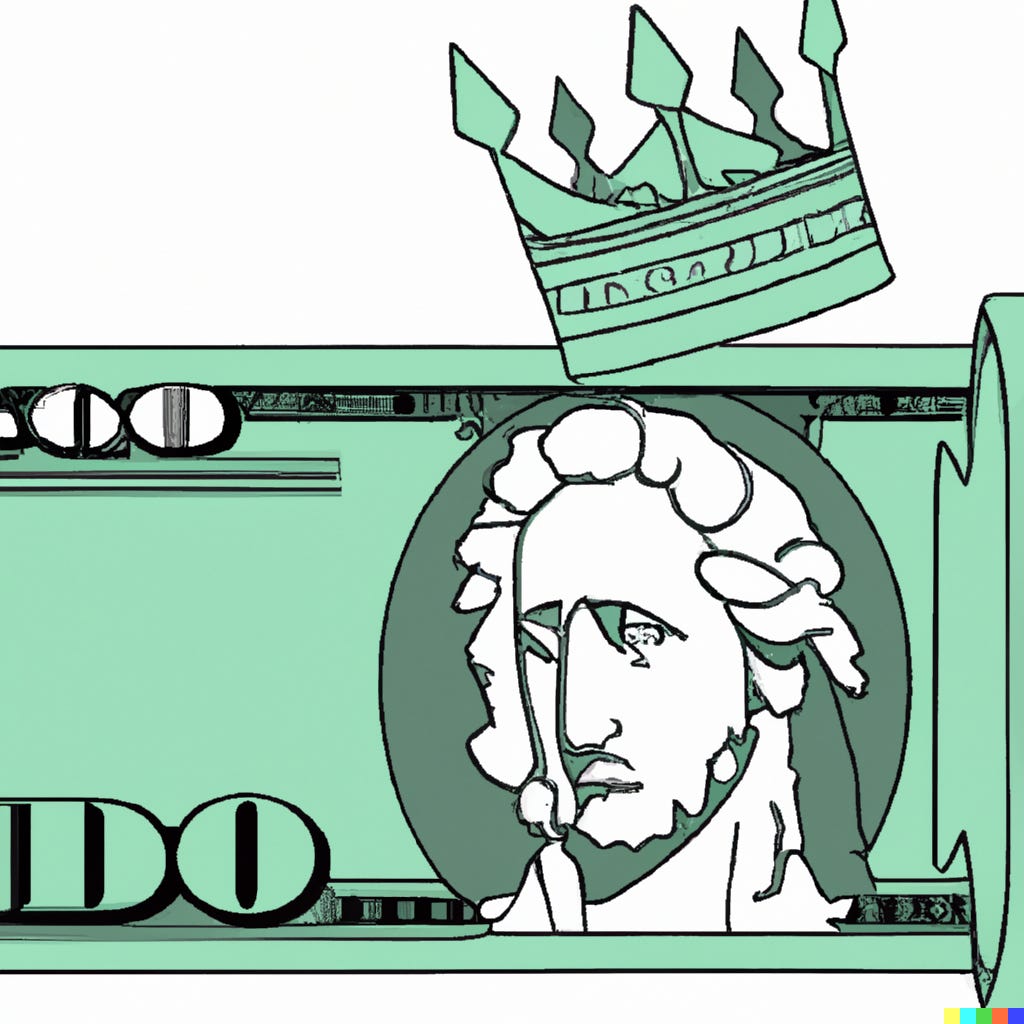
Let us examine the recent talk about the potential end of the US dollar's dominance as the world's reserve currency. Are we witnessing the early stages of a Black Swan event or is it merely the manifestation of our inherent inability to predict and comprehend the intricate dance of geopolitics and economics?
Here's a summary of recent developments:
The US dollar's position as the primary global reserve currency is being challenged as countries seek to reduce Washington's influence.
Recent de-dollarization events include Saudi Arabia considering trading in currencies other than the US dollar, China and France completing an LNG deal using Chinese yuan, Brazil and China trading directly in their own currencies, and India settling transactions in Indian rupees.
The collapse of the petrodollar could impact the world's reserve currency, leading to less trade being invoiced in US dollars and reduced recycling of dollar surpluses into traditional reserve assets like Treasuries.
Saudi Arabia's Finance Minister, Mohammed Al-Jadaan, said the country is open to trading in currencies other than the US dollar.
The US dollar, a symbol of American economic might, has long enjoyed its status as the world's reserve currency, allowing the United States to wield significant political influence through the use of sanctions. But the whispers of the dollar's decline began to grow louder with various events that have unfolded in recent years.
There is no question that the dollar's dominance is being challenged by countries like China, Russia, and others.
Saudi Arabia, a long-standing ally of the United States, has reportedly contemplated pricing its oil sales in Chinese yuan, potentially undermining the petrodollar's status. Meanwhile, the rising influence of China and the European Union has led to an increase in the use of alternative currencies for international trade. Furthermore, digital currencies and cryptocurrencies have gained traction, introducing new players into the global financial ecosystem.
The growing discontent with the dollar's primacy has led to an increasing number of nations seeking refuge in alternative currencies. As these nations distance themselves from the US dollar, they also gain a measure of protection against the sting of American sanctions. The erosion of the dollar's monopoly over global trade, should it continue, could lead to a world where US sanctions are far less powerful, and consequently, America's political influence diminished.
But as we navigate the labyrinth of information, we must avoid the pitfalls of simplistic narratives. Although it should be said that talks about the potential dethroning of the US dollar have been going on for a while. One such voice is Ray Dalio, the founder of Bridgewater Associates, a large American investment management firm.
While his 2021 book, "Principles for Dealing with the Changing World Order: Why Nations Succeed and Fail" doesn't focus solely on the US dollar's supremacy, it does touch upon the topic in the broader context of shifting global power dynamics and the rise and fall of nations.
Dalio examines the historical patterns of great powers and their currencies, emphasizing how economic strength and the role of a reserve currency are intertwined. He highlights the importance of a strong reserve currency, like the US dollar, in facilitating international trade, investment, and providing a stable store of value. However, he also underscores the fact that the status of a reserve currency is never guaranteed and can change over time, as demonstrated by the British pound's decline in the 20th century.
In the 20th century, the British pound experienced a significant decline as a result of various economic and political factors. The process unfolded over several decades, with key events contributing to its fall from prominence. Initially, the pound was the dominant global currency, with the British Empire's extensive trade and political influence bolstering its value.
The decline began with the aftermath of World War I, when Britain's weakened economy and growing debt burden hindered its ability to maintain its global standing. The Great Depression in the 1930s further intensified the pound's decline as countries abandoned the gold standard, leading to devaluation and currency instability.
World War II dealt another blow to the British economy, with massive debts incurred to finance the war effort. Post-war, the US emerged as a new global power, and the US dollar began to challenge the pound's supremacy. The Bretton Woods Agreement in 1944 further solidified the dollar's dominance, with many countries pegging their currencies to the dollar, which was backed by gold.
Throughout the following decades, Britain faced a series of economic challenges, including high inflation, balance of payment deficits, and the decline of its manufacturing sector. These factors, along with the growing influence of the US dollar and the Euro, contributed to the pound's diminished role in global finance by the end of the 20th century.
Throughout the book, Dalio delves into the factors that contribute to the rise and fall of currencies, such as economic policies, fiscal discipline, and geopolitical events. In the case of the US dollar, Dalio draws attention to the growing national debt, the potential for inflation, and the increased willingness of other nations to explore alternatives to the dollar-based system (as evidenced by news headlines in recent years). These factors, combined with the rise of emerging powers like China, may challenge the US dollar's supremacy in the future.
As of December 2022, the US national debt stands at $31,419,689 million ($31.42 trillion). To put this number into context, it's crucial to consider how this level of debt has changed over time, how it compares to other major economies, and the historical growth of the US national debt.
Over the past decade, the US national debt has seen a significant increase, largely driven by government spending on social programs, defense, and stimulus measures to support the economy during crises such as the COVID-19 pandemic. For instance, in December 2012, the national debt was around $16.4 trillion, meaning that it has nearly doubled in a 10-year period.
Comparing the US national debt to other large economies, it's clear that the US holds one of the highest debt levels in the world. However, it's essential to examine the debt-to-GDP ratio, which measures the debt relative to the size of a country's economy. As of December 2022, the US debt-to-GDP ratio is estimated to be around 125%. While this is high, other major economies, such as Japan, have a higher debt-to-GDP ratio, which is over 250%.
Historically, the growth of the US national debt has been influenced by various factors, including wars, recessions, and government spending policies. For example, during World War II, the national debt rose sharply to finance the war effort. Later, in the 1980s and early 2000s, tax cuts and increased military spending contributed to the growth of the debt. In recent years, the debt has continued to rise due to economic stimulus measures and the need to address long-term challenges such as healthcare, social security, and infrastructure.
Dalio also emphasizes the importance of adaptability and resilience in the face of changing global dynamics. He suggests that the US should be prepared to adapt its policies, strengthen its economy, and maintain a competitive edge to ensure the continued dominance of the dollar. At the same time, he acknowledges the potential for a multipolar world, where several currencies share the reserve currency status, as a possible outcome.
While it is tempting to jump to conclusions about the imminent collapse of the petrodollar or the end of the dollar's reign, we must approach the issue carefully.
One must recognize the benefits and resilience that come with the US dollar's entrenched position. The network effect is a powerful force, as the convenience of using a familiar and widely accepted currency cannot be dismissed. Moreover, the US economy has exhibited robustness and adaptability, thanks in part to its diversification and ongoing innovation.
One must also not discount the adaptability and ingenuity of the United States. As the global landscape shifts, it is entirely plausible that America could pivot and find new ways to exert influence, maintaining a strong position on the world stage. After all, as Dalio notes, history is replete with examples of nations and empires adapting to change and maintaining their relevance.
Finally, trust in US institutions and the rule of law has been a pillar of the greenback's strength, providing a stable framework for its continued preeminence. Further, replacing the dollar would be difficult due to its significant share of total foreign reserves.
But even the mighty dollar is not immune to the winds of change.
Black Swan events are, by their very nature, unexpected and difficult to predict. We must, therefore, entertain the possibility that a confluence of factors could lead to the emergence of a new global reserve currency or a digital alternative. It is in this realm of uncertainty that the fragility of the dollar's dominance may lie.
As we venture into the realm of probabilities, it is crucial to remind ourselves of the limitations of our knowledge. Our understanding of the global economic landscape and the forces shaping it is far from complete.
But this is not a reason to not speculate and envision a world where nations gradually ease their dependence on the US dollar, seeking alternative currencies and forms of exchange to insulate themselves from the whims of American policies. The manifestation of such a world is inherently uncertain, as the complex interplay of geopolitics and economics is ever-changing and unpredictable. Nevertheless, let us entertain the possibilities that may arise in such a scenario.
In this envisioned future, the global economic landscape is characterized by a plurality of currencies, each vying for a share of the world's financial transactions. The euro, the yuan, and perhaps even digital currencies such as cryptocurrencies, emerge as formidable alternatives to the once-unrivaled US dollar. As countries diversify their trade and reserve currencies, the power dynamics shift, and the influence once held by the United States becomes more distributed among other players.
This multipolar world could foster a more balanced and equitable distribution of power, with no single nation dominating the global financial system. In such a scenario, the effectiveness of unilateral sanctions weakens, and nations are compelled to engage in more collaborative and diplomatic approaches to resolve disputes and conflicts. In this imagined world, the importance of international institutions and multilateral agreements increases, as nations seek stability and predictability in an increasingly complex and interconnected global economy.
But this is a very rosy picture. Let’s look at a more balanced picture.
It is true that benefits of a multipolar world with diverse currencies include:
Reduced dependence on a single currency: The dominance of one currency, such as the US dollar, can create vulnerabilities for the global economy. In a multipolar world, countries would not be as reliant on a single currency, mitigating the risk of economic shocks originating from one nation.
More balanced global economic power: A multipolar world could lead to a more equitable distribution of global economic power, with no single country or region dominating global markets. This balance could potentially reduce the risk of aggressive economic policies and promote cooperation among nations.
Enhanced economic resilience: A diversified global economy with multiple currencies in use can help countries better manage their economic risks, enhance their financial stability, and potentially reduce the impact of economic crises.
However, potential challenges in a multipolar world with diverse currencies include:
Increased geopolitical tensions: A multipolar world might lead to more intense competition among major powers, which could heighten geopolitical tensions and increase the risk of conflict.
Difficulty in coordinating global economic policies: A multipolar world could make it harder for countries to cooperate on global economic issues, as each major power may have differing priorities and interests. This could hinder the effectiveness of international organizations and reduce the ability to address global challenges such as climate change or financial crises.
Fluctuations in currency values: Multiple currencies in use could lead to increased volatility in exchange rates, which might create uncertainties for international trade and investment.
Now let us jump to the key question. How likely is this future to manifest? As we have seen in recent years, nations are indeed taking steps towards de-dollarization, seeking alternative means to conduct trade and protect themselves from the effects of US sanctions. However, the entrenchment of the US dollar in the global financial system cannot be easily uprooted. Let’s review some more facts.
US dollar share of global foreign exchange reserves drops to a 25-year low (as of 2021).
US dollar accounts for approximately 59% of total foreign exchange reserves worldwide. (US dollar's share of global foreign exchange reserves decreased from 71% to 59% over the last two decades.)
Euro accounts for about 20% of total foreign exchange reserves worldwide.
Chinese renminbi accounts for roughly 2.8% of global foreign exchange reserves.
Despite the downward trend, it is still very difficult for another currency to take over the position held by the US dollar as the world reserve currency.
Foreign exchange reserves are assets held by central banks and monetary authorities in different currencies, primarily used to support their liabilities and influence monetary policy. Reserve currency is a foreign currency held in significant quantities by governments and institutions, which can be used for international transactions and to stabilize their own currency.
Total assets held by the US Federal Reserve grew substantially from 2019 to 2021, but they have experienced fluctuations from August 2022 to February 2023.
And as we have seen, the US dollar has the largest share of foreign currency reserves held by other nations.
Thus, as long as the U.S. remains the world’s strongest military power and economic power, it will be able to maintain some kind of stability for the US dollar. In which case, it is hard to imagine central banks around the world ditching it too soon. However, for countries that wish to escape US sanctions and the weaponization of the US dollar, there is an alternative that could be seen as the lesser of two evils.
It's also worth noting that a significant proportion of international trade is still conducted in US dollars, despite the decrease in its share of global foreign exchange reserves. Thus, the worst-case scenario for the US dollar seems to be a more multilateral future where the currency loses influence in some areas but remains dominant in others. But even such a future is far from certain, and far from safe.
Let us summarize: in a world laden with uncertainty, the US dollar's dominance as the primary global reserve currency faces challenges. Countries increasingly seek to reduce Washington's influence, with recent de-dollarization events adding to these whispers of decline. However, the greenback's entrenched position and the network effect remain powerful forces that could ensure its continued preeminence.
The emergence of a multipolar world, where various currencies are in use, could lead to a more balanced distribution of global economic power, but may also introduce heightened geopolitical tensions and difficulties in coordinating global economic policies. While it's hard to predict the future, the worst-case scenario for the US dollar may be a multilateral future where its influence wanes in some areas while remaining dominant in others.