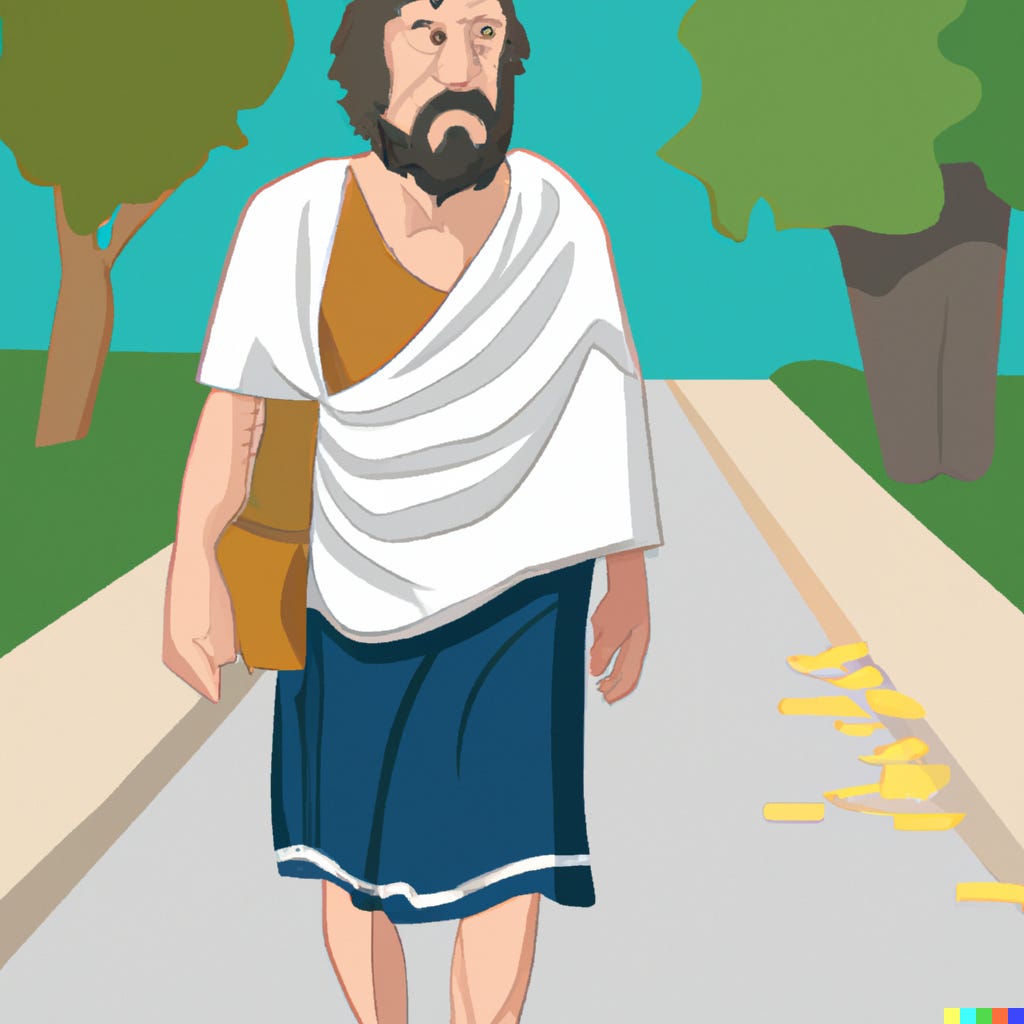
Know Thyself
This ancient Greek aphorism urges introspection and self-knowledge. However, overemphasis on self can lead to narcissism and a lack of empathy for others.
"Know thyself" is a timeless piece of wisdom, often attributed to Socrates, and immortalized in literature, self-help books, and movies. At its core, it seems intuitive and profound. It suggests that the key to making the right decisions, finding happiness, or achieving success lies in deeply understanding our own values, desires, strengths, and weaknesses.
Popularity
This idea is widely held and repeatedly echoed. It's found in every corner of popular culture. For instance, in Disney's "The Lion King," the wise baboon Rafiki teaches Simba to "look inside himself" to understand his true identity. In the business world, it's common advice for aspiring entrepreneurs to understand their own motivations, strengths, and limitations before launching a venture.
The Misconception
Despite its apparent wisdom, the idea of "know thyself" can be misleading. It assumes a static and singular 'self' that can be discovered and understood. Yet, the reality is more complex. Psychological research shows that our identities are fluid and multifaceted, often shaped by our environment, experiences, and interactions. We play different roles and express different aspects of ourselves in different contexts.
The Counterintuitive Truth
Moreover, the relentless pursuit of self-knowledge can sometimes lead to narcissism or self-absorption, preventing us from truly understanding and empathizing with others. There are also times when our intuition or gut feelings can mislead us. Nobel laureate Daniel Kahneman's work in behavioral economics shows that we are often blind to our own biases, and our introspection can be flawed.
Instead of focusing solely on understanding ourselves, perhaps we should also learn to acknowledge and embrace the mystery and changeability of our nature. And perhaps, we should place equal, if not more emphasis on understanding others and the world around us. After all, we are not isolated beings, but deeply interconnected with the world around us.
Thus, while "know thyself" is not without its value, its usefulness and truth are not absolute. It should not be taken as an unquestioned axiom, but seen as one piece of the puzzle that forms our complex human experience.
The Unexamined Life is not Worth Living
This Socratic maxim encourages critical thinking, but can also lead to constant self-doubt and indecision. Sometimes, action without overthinking is what's needed.
"The unexamined life is not worth living" is a renowned dictum by Socrates, recorded by his student Plato in the dialogue "Apology". The quote implies that a life lived without introspection, philosophical inquiry, and continuous self-evaluation is devoid of value.
Popularity
This saying is foundational to many philosophies and psychological perspectives, emphasizing the need for introspection and personal growth. For instance, it resonates with the tenets of psychoanalysis, where self-examination is key to understanding and resolving internal conflicts. The self-help industry also thrives on this concept, pushing people to incessantly probe their thoughts, feelings, and experiences to live a more meaningful life.
The Misconception
However, the axiom "the unexamined life is not worth living" can be overly prescriptive, suggesting that a life without constant introspection lacks value or meaning. This is an unfair reduction of human experience and diversity.
The Counterintuitive Truth
The richness of life is not exclusively reserved for those who dedicate their time to introspection and philosophical musings. Often, it is found in the simplest of experiences - a good meal, a meaningful conversation, a mesmerizing sunset, a book that touches the soul, or even in the toil of hard work. These seemingly ordinary moments can offer profound insights and joy, as they connect us to the world around us and to our own being in its most natural state.
Moreover, an overemphasis on introspection can paradoxically obstruct our understanding of self and life. Constant analysis can lead to a form of cognitive entrapment, where the person becomes excessively focused on internal experiences, fostering a distorted view of reality.
Psychologists have found that excessive introspection can indeed lead to negative effects such as anxiety, depressive thoughts, and even mental health disorders. Psychoanalyst Adam Phillips, in his book "Missing Out", notes that an obsessive quest for self-analysis can cause us to miss out on the spontaneity and unpredictability of life, which often brings joy, growth, and wisdom.
The Impact of AI
With the rise of artificial intelligence, there's an intriguing challenge to the ethos of incessant introspection. AI technologies are engineered to process, analyze, and learn from vast amounts of data, effectively performing a kind of 'self-examination' at a scale and speed unachievable by humans. Yet, despite their analytical prowess, we don't attribute to these systems the depth and richness we associate with a meaningful human life.
This disparity underscores the importance of elements in our lives that transcend rational calculation and analysis. Empathy, love, joy, art, and the appreciation of beauty, for instance, are deeply human experiences that add value to our lives in ways that defy quantitative measurement. They show us that there is more to a meaningful life than incessant introspection, reminding us of our unique human capacity to perceive, feel, and connect with the world around us on a profound level.
The Deeper Insight
It might be more useful to interpret Socrates' quote not as a mandate for continuous self-examination, but as an encouragement for reflective moments that can inform our decisions and behavior. The key is to strike a balance between self-awareness and living in the moment, between introspection and extrospection, and between self-analysis and acceptance.
A life well-lived, therefore, might not be one that's incessantly examined, but one that encompasses a spectrum of experiences - both examined and unexamined, thought-filled and spontaneous, introspective and extrospective. Our lives gain value through the rich tapestry of these diverse experiences, transcending the limitations of any single philosophical maxim.
In this age of AI, the value of human life can be appreciated more holistically, acknowledging the significance of experiences and qualities that set us apart from any analytical system. As we navigate this new era, perhaps we might find that an examined life is just one facet of a life worth living.